


In the Room Together: An Update on the Autonomys Network Auto Drive and healthpass1™ Integration


This month the Autonomys Network and healthpass1 teams met face to face in New York, alongside other partners healthpass1™ has brought together. Here is what healthpass1 has been achieving, an update on their estimated timeline for the Auto Drive integration, and how you can get involved today.

Some partnerships live in contracts and calendar invites. The best ones eventually put everyone in the same room. Earlier this month, Todd Ruoff, CEO of the Autonomys Network, joined the healthpass1 team in person in New York, together with other partners contributing to the healthpass1 stack.
A partner meetup in New York
The gathering was intimate and hands on. healthpass1, Autonomys, and three other partners came together in force. Autonomys provides healthpass1 with a decentralized storage foundation through Auto Drive. Over a working lunch and a series of breakout conversations across healthcare, technology, and infrastructure, everyone left aligned on a shared goal: telling this story together.
Who healthpass1 is, and the momentum behind them
healthpass1 helps make it simple to keep all your health records and fitness information in one private, easy-to-manage place. You decide what you share, who sees it, and for how long. Built on a secure, decentralized foundation with optional AI-powered insights, healthpass1 keeps everything encrypted and in your control. Their tagline puts it simply: the 1 (and only) health passport you need. Simple. Secure. Shareable. The product is patent pending and designed to meet the expectations of highly regulated industries.
The last few weeks have brought real momentum.
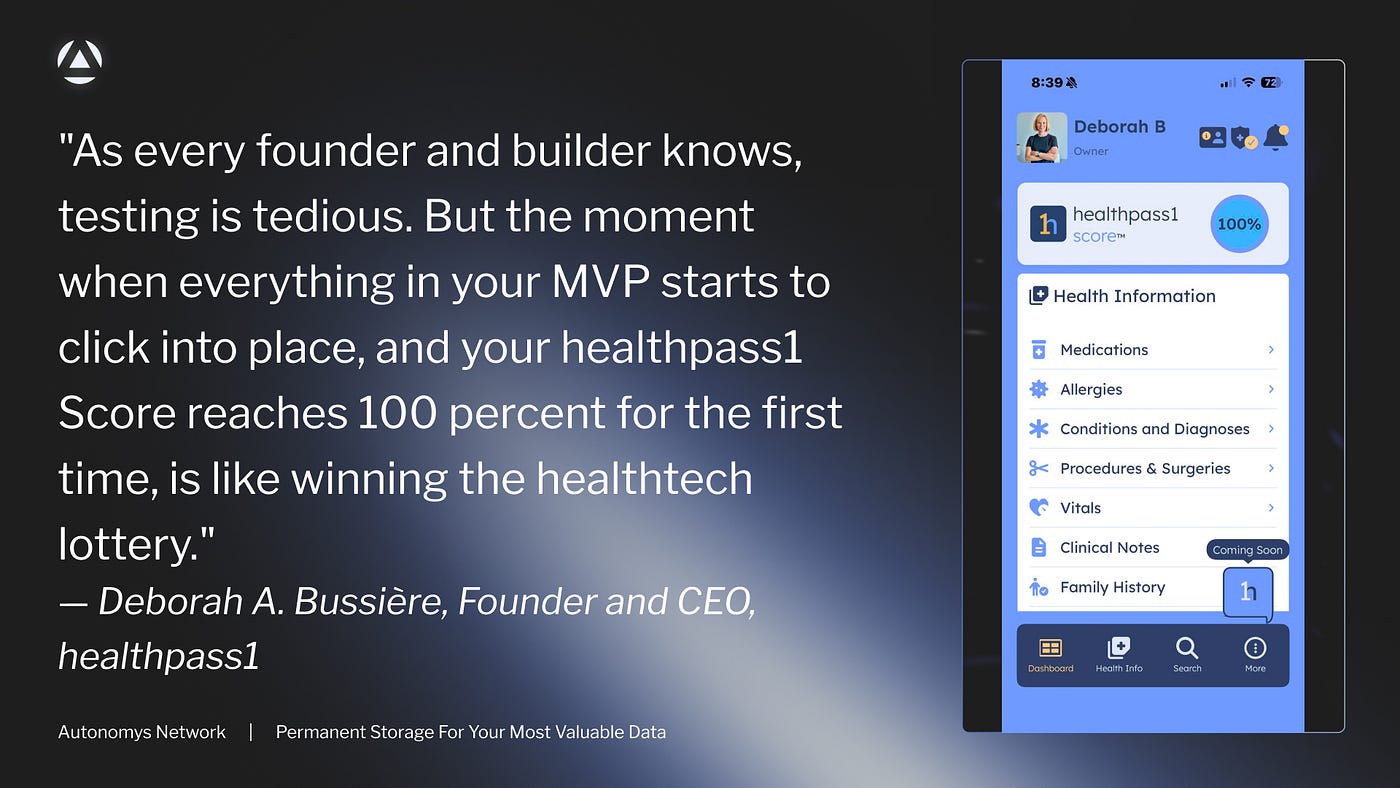
The MVP reached a milestone. The healthpass1 Score hit 100 percent, a signal that the core experience is coming together.
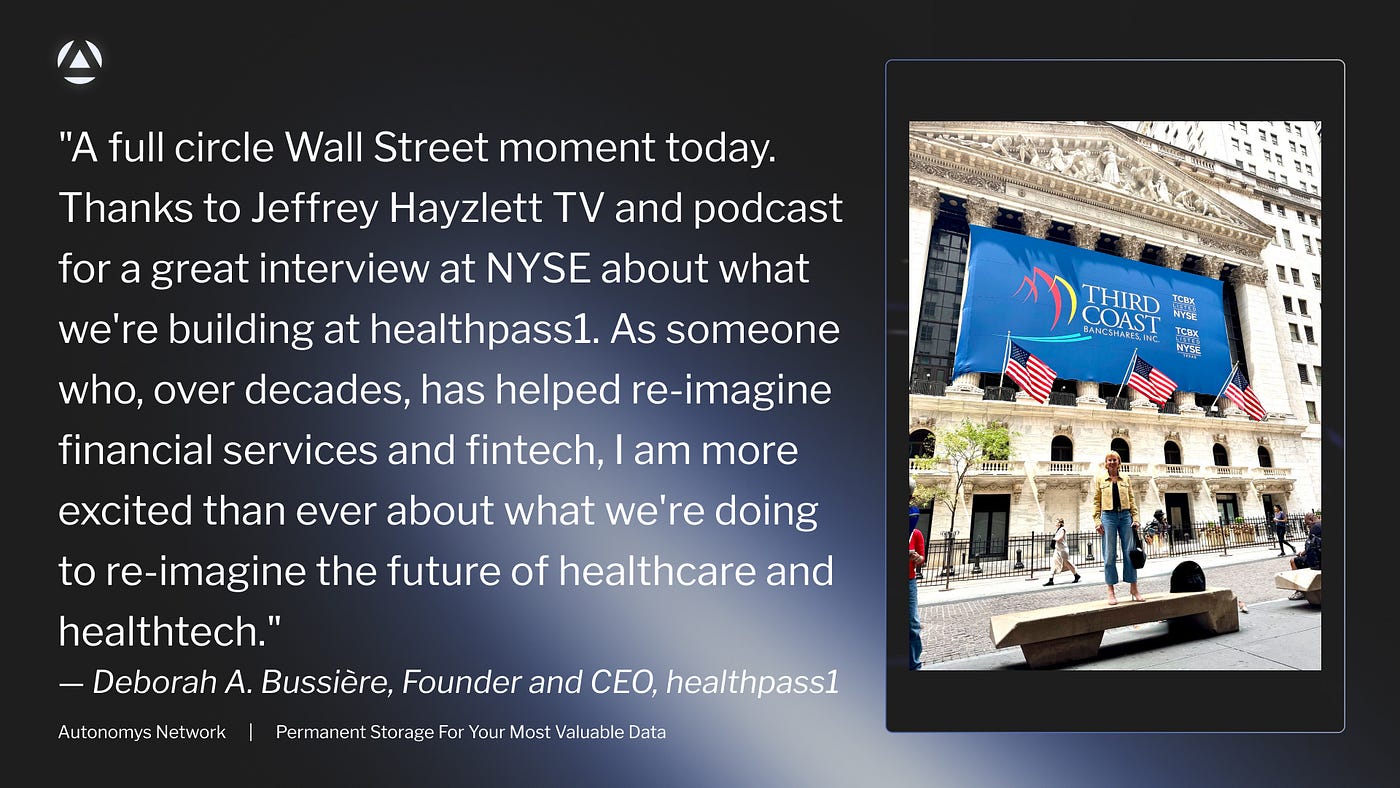
healthpass1 went to Wall Street. Deborah A. Bussière was interviewed by Jeffrey Hayzlett for a TV and podcast episode filmed at the New York Stock Exchange, scheduled to air in September.
Investors are taking notice. healthpass1 was named the “Unicorn Spotlight” company in this month’s Pitch and Run newsletter, reaching a broad audience of investors, founders, and startup leaders. It was also featured in the Community Spotlight of nextNYC, Charlie O’Donnell’s weekly newsletter for New York’s tech and innovation community.
The healthpass1 and Auto Drive integration
For anyone joining the story now, here is the integration in the exact terms both teams have agreed on.
healthpass1, which helps make it simple to keep all your health and wellness information in one private, easy-to-manage place, has selected Autonomys Network’s Auto Drive as a secure, decentralized storage foundation underlying its platform. Auto Drive’s client-side encryption architecture ensures that data is encrypted on the user’s device before it ever touches the network, meaning no storage operator, no network participant, and no third party, including healthpass1, has access to unencrypted file content. Encryption keys are generated and held exclusively by the user, making the data’s permanence and privacy inseparable. Auto Drive is purpose-built by the Autonomys Network to ensure that stored data persists without dependence on any single company’s continued operation; however if a user deletes their encryption key, that data becomes cryptographically unrecoverable by anyone, including Autonomys and healthpass1.
Auto Drive is developed and operated by the Autonomys Network, a Layer-1 infrastructure platform with a global storage network of independent operators pledging petabytes of SSD space. For healthpass1, that means the health information its users store is designed to be private and secure from the moment it is written, on infrastructure no single company controls.
What comes next
Autonomys Network is proud to serve as a decentralized storage provider for healthpass1, and prouder still that a team with this depth of experience in healthcare, financial services, technology, and privacy chose Auto Drive to protect what is arguably the most personal data a person generates in a lifetime. healthpass1 is targeting September for the integration, and we will keep sharing updates as that work comes together.
If you want to follow the healthpass1 journey or get involved:
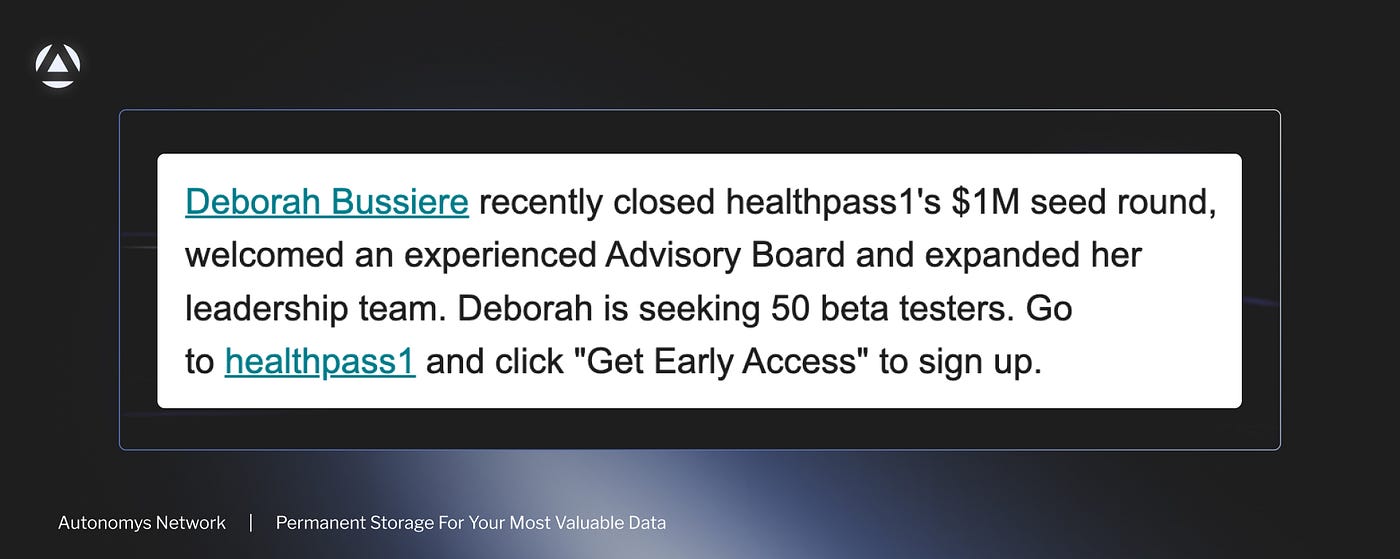
- Visit healthpass1.com and click “Get Early Access” to become a beta tester and help improve the platform before broader launch.
- Follow healthpass1 on LinkedIn to keep up with their progress.
And if you are building something where your data needs to stay private, secure, and permanent, you can start with Auto Drive today.
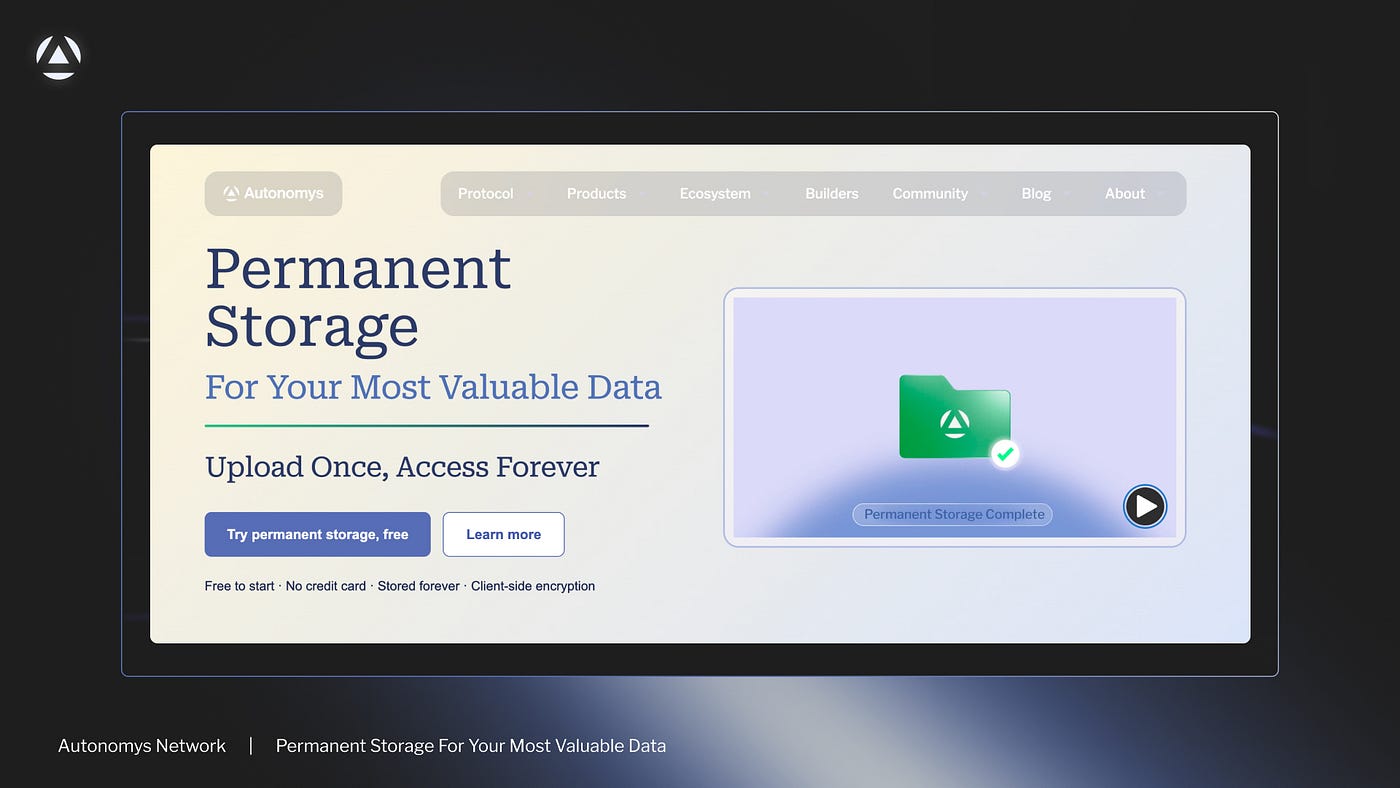
Sign up for free at ai3.storage.
DISCLAIMER: healthpass1™ is a personal health information management tool and does not provide medical advice, diagnosis, or treatment. The information stored and organized through healthpass1 is not a substitute for professional medical advice, diagnosis, or treatment. Always seek the advice of your physician or other qualified health provider with any questions you may have regarding a medical condition. Never disregard professional medical advice or delay seeking it because of information accessed through healthpass1.
When AI Designs Biology, the Safeguard Is a Record No One Can Rewrite
When AI Designs Biology, the Safeguard Is a Record No One Can Rewrite
Researchers at Stanford and the Arc Institute used AI to design 16 working viruses. The bacteriophages cannot harm people. The capability behind them is another matter, and it is arriving faster than the oversight meant to govern it. Every safeguard now under discussion rests on one quiet requirement: a permanent record of what was designed, requested, and built, that no one can alter or erase. That kind of record is exactly what Autonomys Network’s Auto Drive was built to provide.
In August 2026, a team at Stanford University and the Arc Institute reported something that had not been done before. Using the genome-language models Evo 1 and Evo 2, they generated complete viral genomes that do not occur in nature, synthesized the DNA, and confirmed that 16 of roughly 285 candidates were functional bacteriophages (any of a group of viruses that infect bacteria). The work was published in Science.
Two parts of that sentence deserve equal weight. The first is that it is a real advance. Bacteriophages are viruses that infect bacteria, and designed phages could one day be aimed at the antibiotic-resistant infections that conventional drugs are steadily losing ground against. The second is that the capability is general. The kind of system that designs a harmless phage is the same kind of system that, aimed at a different target, could design something dangerous.
Precision matters here, because the precision is the reassurance. The phages in this study were built from ΦX174, a virus that infects laboratory strains of E. coli. They pose no threat to people. The concern is not these organisms. It is that genome design, DNA synthesis, and automated laboratories are each advancing on their own timeline, and the safeguards meant to sit between them are not keeping pace.
That gap is where the public conversation usually stops. Breakthrough, or biosecurity risk. It is the wrong place to stop, because it skips the question that decides whether any safeguard works at all. When an AI system designs a biological sequence, can anyone prove afterward what was designed, who asked for it, whether any human asked at all or an AI agent acted on its own, and what was actually made?
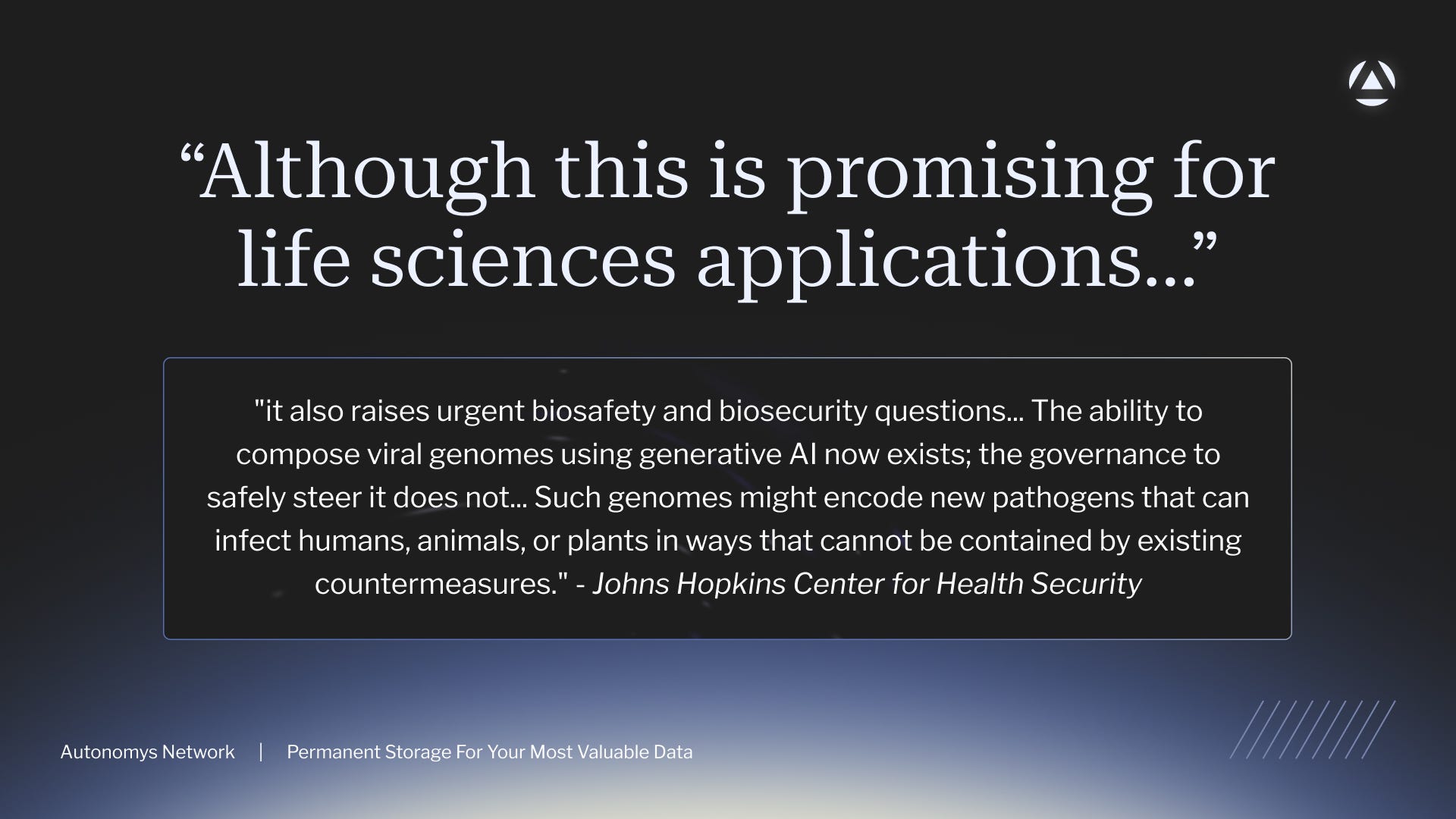
This is not a fringe worry. In a companion article in Science, “AI-designed viral genomes,” researchers at the Johns Hopkins Center for Health Security wrote: “Although this is promising for life sciences applications, it also raises urgent biosafety and biosecurity questions.” Their sharpest line named the gap directly: “The ability to compose viral genomes using generative AI now exists; the governance to safely steer it does not.” They flagged one line of work they say should not be pursued at all, the design of eukaryote-infecting pathogens, the kind behind disease in humans, animals, and plants. “Such genomes,” they warned, “might encode new pathogens that can infect humans, animals, or plants in ways that cannot be contained by existing countermeasures.”
Look at the safeguards that experts are already calling for. Screening the DNA synthesis orders that turn a digital sequence into physical material. Controlling who can reach the most capable design tools. Monitoring for unusual patterns of sequence generation. Every one of those controls produces a record, and a safeguard is only ever as strong as the record behind it. If the log of a dangerous request can be quietly edited or deleted, screening and monitoring lose their meaning. The control still runs. The proof that it ran, and what it saw, does not survive.
Picture the moment that record matters most. An incident, an audit, or a regulator asking, months or years later, what really happened. At that moment an audit trail is either trustworthy or it is worthless, with no setting in between. If the party under scrutiny could have altered the record, no one outside it can rely on it, and the inquiry stalls before it starts.
This is the same accountability gap that runs through AI everywhere, and biology raises the stakes to their limit. Provenance is the heart of it. For that provenance to support oversight, it has to be two things at once. It has to be permanent, so it is still there whenever someone needs it. And it has to be tamper-evident, so that anyone can confirm it was not changed after the fact. Conventional systems offer neither. Logs live in databases that administrators can rewrite, and records that turn out to be inconvenient have a way of quietly disappearing.
Auto Drive, Autonomys Network’s gateway to permanent storage, was built to solve exactly this problem. A record can fail in two ways. It can disappear, or it can be altered. Permanence prevents the first, immutability the second. A provenance trail for AI-designed biology needs both at once, and most storage manages one at best.
What that combination buys is verification without exposure. Anyone can confirm that a record was not altered, without having to trust whoever stored it. When the sequences themselves are sensitive, they can be encrypted, with the keys held by the institution that owns them, so the record stays publicly verifiable while its contents stay private. No single operator, the storage provider included, can quietly rewrite or remove an entry. That is what turns a log into evidence, and evidence is what oversight of any dual-use technology actually runs on.
The governance the Johns Hopkins authors say is missing will not come from any single measure. The screening, access controls, and oversight already being called for all do part of the work. A permanent, verifiable record is a different part, and only one part: the evidence layer beneath them, the thing that makes every control auditable. It is the part Auto Drive provides. You can build careful oversight on top of records you can trust. You cannot reconstruct what was quietly erased, and you cannot govern what was never reliably kept.
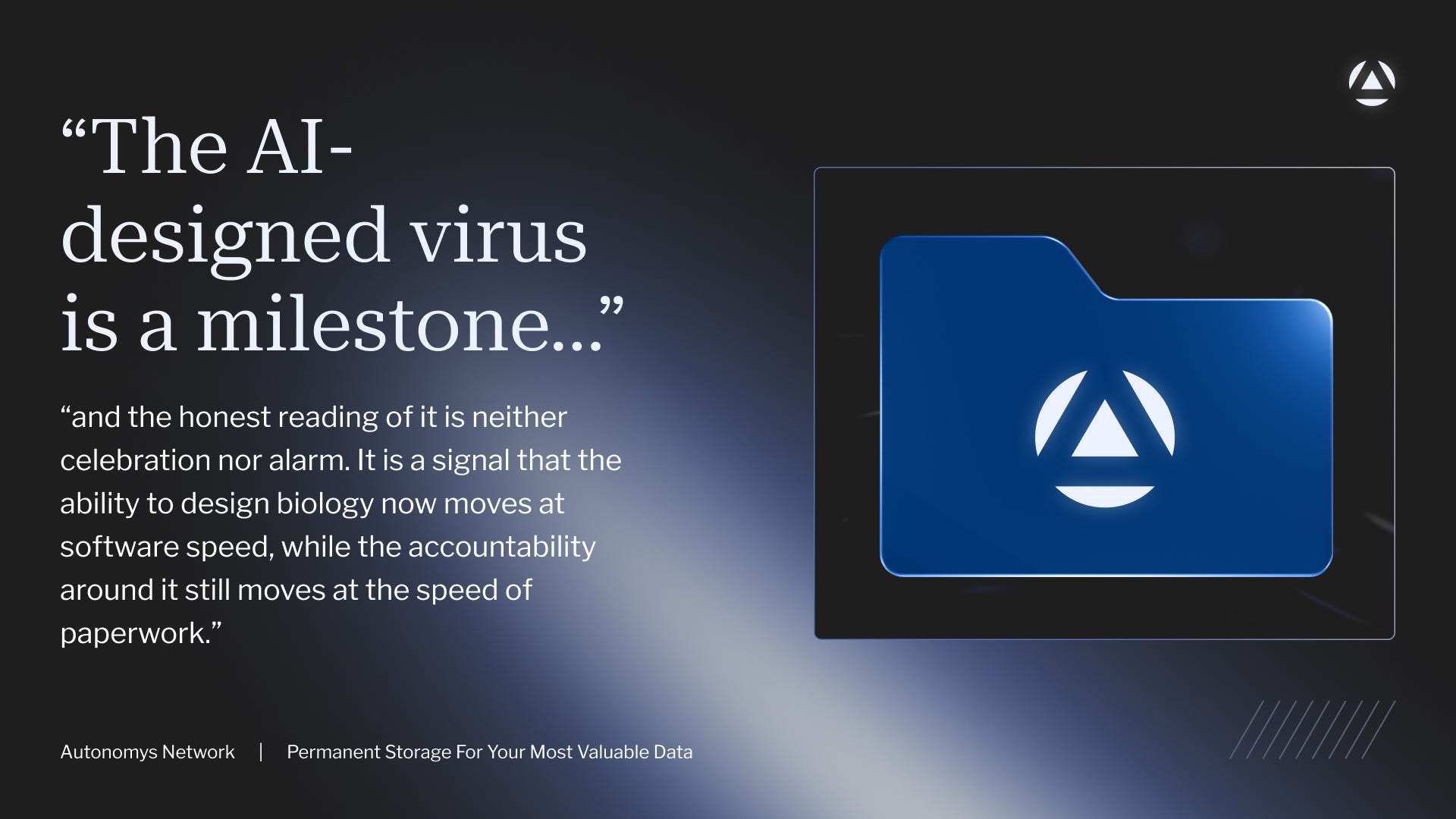
The AI-designed virus is a milestone, and the honest reading of it is neither celebration nor alarm. It is a signal that the ability to design biology now moves at software speed, while the accountability around it still moves at the speed of paperwork. Closing that gap starts with the least glamorous part of the whole system: a record of what happened that no one can rewrite.
That record is not enough on its own. But no credible oversight will work without it.
None of this is a future capability.
Auto Drive is free to start, with 20 MB of upload and 5 GB of download each month at ai3.storage, and the Subspace Foundation Grants Program (the Subspace Foundation oversees the Autonomys Network) coordinates larger storage grants for the teams that need them.
References
- Les-Leigh. “Scientists Created 16 Synthetic Viruses Using AI: Is This a Breakthrough or Biosecurity Risk?” TechRound, August 10, 2026. https://techround.co.uk/artificial-intelligence/scientists-created-16-synthetic-viruses-using-ai-is-this-a-breakthrough-or-biosecurity-risk/
- King, S., et al. “Generative design of bacteriophages with genome language models.” Science, 2026. https://doi.org/10.1126/science.aec2657
- “AI-designed viral genomes.” Science, 2026. https://doi.org/10.1126/science.aej8512
- “AI creates 16 new viruses from scratch, showing promise for drug resistance and drawing warnings about potential for misuse.” CNN, August 6, 2026. https://www.cnn.com/2026/08/06/health/ai-viruses-bacteriophages
AI Has a History Problem
Across governance, security, and law, independent research groups are arriving at the same conclusion: AI systems need records that anyone can verify and no one can quietly change. That is not a product feature. It is critical infrastructure, and it has already been built. Yet, most of the teams that need it do not know it is ready to use.
An AI system makes a decision. It approves or denies a loan. It flags an insurance claim. It routes a patient, prices a policy, or executes a trade. Weeks later, someone asks a simple question: what actually happened, and can you prove the record of it was not changed after the fact?
For most systems in production today, the honest answer is no. With Auto Drive, Autonomys Network’s gateway to permanent storage, it does not have to be.
The problem is mundane. Conventional logs are entries in a database, and entries in a database can be edited. In a 2024 joint advisory, the U.S. Cybersecurity and Infrastructure Security Agency, the NSA, and allied cyber agencies note that “some malicious actors are known to modify or delete local system event logs to avoid detection and to delay or degrade the efficacy of cyber security incident response.” The record exists. Its integrity does not. That gap is harmless when a log is a debugging convenience. It stops being harmless when the log is the only evidence of what an autonomous system actually did.
A quiet consensus is forming
What makes this moment different is not one paper or one company. It is that researchers working from unrelated starting points have converged on the same missing piece within the span of weeks.
Start with governance. In “AgentBound: Verifiable Behavioral Governance for Autonomous AI Agents,” Anuj Kaul, Qianlong Lan, and Pranay Gupta describe a shift in what it means to govern an autonomous system. AgentBound, they write, provides “a deterministic governance layer between authorization and execution, transforming governance from a process that must be trusted into one that can be independently verified.” That distinction is the whole point. A policy you have to take on faith is not a control. A policy whose enforcement leaves a record anyone can check is. AgentBound builds on an idea it names, a “Right to History” for agents, and cites work on “tamper-evident agent execution records” that let an agent’s past be proven rather than asserted.
Security research is arriving from another direction. In an early formal model titled “Toward Cryptographically Verifiable Authorization for Autonomous AI Agents,” M. Llambí-Morillas and D. Fernández-Fernández propose treating authorization itself as something you can prove. In their words, “Authorization decisions for autonomous AI agents can be represented as cryptographically verifiable relations that jointly bind an agent principal, a concrete authorization request, an execution context and satisfaction of an applicable policy.” Put plainly: it is not enough to see what an agent did. You should be able to prove it was allowed to do it.
The same idea is already being built into working systems. A benchmark for AI trading agents hash-chains every decision an agent records, so that any change to the record announces itself. The authors note that “an inconsistent edit… breaks the chain at the first altered record.” This is a finance evaluation tool, not a governance manifesto, and that is exactly why it matters. When practitioners building unrelated systems independently reach for the same construction, it has stopped being a novelty and started being vital infrastructure.
The complication that makes the case stronger
Here is where a weaker argument would overreach, and where the research is more honest than most marketing.
A permanent, tamper-evident record is necessary. It is not, on its own, sufficient. The most rigorous paper in this group makes precisely that point. In “From Runtime Records to Legal Findings,” Jeroen Janssen of Apparens sets a bar for when an AI system’s records can actually support a legal or regulatory finding, and he is blunt about the limit: “The claim is one of necessity, not sufficiency.” A record can be perfectly tamper-evident and still prove nothing, because, as he writes, “It may be incomplete, curated, falsely typed, produced in bad faith, or paired with incompetent decision-making or delayed intervention.”
This is the right way to think about it, and it strengthens the case for permanent storage rather than weakening it. You can layer structure, context, and human oversight on top of a record you can trust. You cannot add trust back to a record that was silently changed. Integrity is the floor. It is also the one part of the stack you cannot retrofit. Everything else in an audit trail can be improved after the fact. Whether the underlying record can be altered cannot.
The regulatory stakes
For anyone deploying AI in a regulated context, these records are quietly becoming legal instruments. Memory with delete rights is policy. Memory without them is evidence.
The clearest example is the EU AI Act. Its record-keeping requirement for high-risk systems, Article 12, requires those systems to allow for the automatic recording of events across the entire lifetime of the system. Logs that persist. Logs that hold up. In practice, that means records that are permanent, that cannot be altered, and that can be verified.
The timeline is worth stating accurately, because precision here is itself a form of credibility. In 2026, the European Union’s Digital Omnibus package deferred the high-risk obligations. Stand-alone high-risk systems in the EU AI Act’s Annex III must now comply by December 2, 2027, and high-risk systems embedded in regulated products by August 2, 2028. The transparency obligations, including the requirement to disclose when a user is interacting with AI, took effect on August 2, 2026 as originally scheduled. The requirement did not shrink. The clock reset. For record-keeping failures, the Act’s penalties reach up to 15 million euros or 3 percent of worldwide annual turnover, whichever is higher.
The strategic reading is straightforward. A deferred deadline is a design window, not a reprieve. Organizations that use the extra runway to build on records they can prove will be ready when the date arrives. Those that treat it as permission to wait will be rebuilding their evidence trail under pressure, which is the most expensive time to do it.
The infrastructure the research is pointing at
Strip away the different vocabularies, and every one of these papers is describing the same property: a record that is always available and that no one can change without detection. That is a storage problem before it is anything else.
It is the problem Auto Drive was built to solve. Auto Drive is a storage service from the Autonomys Network that keeps data permanent and immutable. Two words that often get blurred are worth separating here, because the difference is the entire value. Permanent means the data is always available. Immutable means it cannot be changed. Most storage gives you one of these, or neither. Auto Drive gives you both.
The contrast with the most popular options? Centralized cloud storage can be deleted or modified by whoever controls the account. Pinning-based storage keeps your data only as long as you keep paying to pin it. Auto Drive holds data across a globally distributed network of nodes with no pinning to maintain, no expiration date, and anyone can confirm that a file was not altered without having to trust the party that stored it. That verification does not depend on reading the contents, so the file can be encrypted. Teams that need privacy can choose to encrypt a file and hold their own keys. Anyone can still verify the record is unaltered, but only the key holders can decrypt the file. No single party, Autonomys included, can rewrite or remove a record. That is what turns a log into evidence.
Try permanent storage in under five minutes
For teams building where the record must withstand scrutiny over time, this is available today, not on a roadmap. Auto Drive is free to start, with 20 MB of upload and 5 GB of download each month at ai3.storage, and the Subspace Foundation Grants Program (the Subspace Foundation oversees the Autonomys Network) coordinates larger storage grants for teams building where permanence is not optional.
In recent weeks, from a dozen directions at once, independent researchers pointed at the same missing layer: a record no one can alter in secret. A history you can prove may not be the whole answer to trustworthy AI, but nothing else works without it.
References
- Kaul, A., Lan, Q., and Gupta, P. “AgentBound: Verifiable Behavioral Governance for Autonomous AI Agents.” arXiv:2606.30970, June 29, 2026. https://arxiv.org/abs/2606.30970
- Llambí-Morillas, M., and Fernández-Fernández, D. “Toward Cryptographically Verifiable Authorization for Autonomous AI Agents: A Security Hypothesis, Preliminary Formal Model, and Proof-of-Concept Implementation.” arXiv:2607.21325, July 23, 2026. https://arxiv.org/abs/2607.21325
- Qu, B., and Chen, M. “CLQT: A Closed-Loop, Cost-Aware, Strategy-Consistent Benchmark for Diagnostic Evaluation of LLM Portfolio-Management Agents.” arXiv:2606.29771, June 29, 2026. https://arxiv.org/abs/2606.29771
- Janssen, J. (Apparens). “From Runtime Records to Legal Findings: An Evidentiary-Adequacy Criterion for Agentic AI Oversight.” arXiv:2607.00941, July 2026. https://arxiv.org/abs/2607.00941
- “Best Practices for Event Logging and Threat Detection.” Joint cybersecurity advisory led by ASD’s ACSC with CISA, the FBI, the NSA, and international partners, August 2024. https://www.cisa.gov/resources-tools/resources/best-practices-event-logging-and-threat-detection
- “Regulation (EU) 2026/1744 (Digital Omnibus on AI), amending Regulation (EU) 2024/1689 (the AI Act).” Official Journal of the European Union, July 8, 2026. https://eur-lex.europa.eu/eli/reg/2026/1744/oj
Introducing Guardians of Growth Season 2: Boosted Staking Rewards Are Back With 5 Million More AI3
Published on behalf of the Subspace Foundation.
A second season of staking rewards will keep the operator and nominator community strong while the Autonomys Network continues to grow toward sustainable, organic transaction activity.
A healthy network needs an active staking community from day one, long before real usage can pay for it. Closing that gap is what Guardians of Growth was built to do.
The program is run by the Subspace Foundation, which oversees the Autonomys Network. Its role is to support the network’s growth and resilience. The Foundation launched Guardians of Growth in August 2025 with a clear goal: build strong staking participation and support a healthy ecosystem of operators, who run the network’s infrastructure, and nominators, who stake their AI3 behind them. The program would sustain that community while activity on the network grew toward generating its own transaction fees.
One year on, the community has answered. At its peak, 41,270,560 AI3 was committed to operators. Around 39.9 million AI3 remains committed today, roughly one-third of the circulating supply, spread across 5 nominator positions and four active operators. Season 1 did what it set out to do. It built meaningful staking participation from a standing start and made the staking process familiar to a growing community.
Why a second season
Season 1 was always meant to be a bridge. It would carry operators and nominators through the early period, before organic network activity generated a larger share of their rewards.
That activity has grown more slowly than hoped. One year in, usage and fee generation are not yet where the Foundation expected them to be. The ecosystem needs more time. The staking community, meanwhile, remains strong.
Season 1 is still concluding as announced. Season 2 is a new and separately funded program that extends that bridge, providing continuity for the people who stake while giving the wider ecosystem room to grow. It is not a substitute for adoption. The Foundation and Autonomys Network continue to pursue product, developer and adoption work aimed at increasing real network usage. Guardians of Growth simply provides a stable base from which that work can continue.
What Season 2 commits
The Foundation will allocate a further 5,000,000 AI3 to Season 2. The additional AI3 comes from the Foundation’s Near-Term Treasury, which is earmarked for ecosystem development. Across both seasons, that brings the total to 10,000,000 AI3, exactly one percent of total token supply, dedicated to bootstrapping staking and supporting the execution domain ecosystem.
Rewards will be distributed over approximately twelve months. Season 2 is expected to begin once Season 1 concludes, targeting around the end of August 2026, with Season 2 completion targeted around the end of August 2027. Actual timing may vary with block production and live network conditions, so treat these as operational targets rather than fixed dates.
Everything that made Season 1 trustworthy stays in place. Staking remains fully non-custodial: nominators keep control of their AI3 at all times and never hand custody to the Foundation. Rewards are protocol-native, distributed through the same mechanism that handles ordinary transaction fees. And the program remains open and verifiable, with the Guardians of Growth Auto EVM Vault, operational wallets and reward transactions all followable on-chain. The Foundation will keep publishing staking figures in the End of Month reports and will release a retrospective once Season 2 concludes.
How it works
The mechanism is deliberately simple. On a regular cadence, the Foundation submits a simple transaction on the Auto EVM domain and attaches a tip. Operators that include that transaction in a block earn a share of the tip, and their nominators automatically receive a proportional share through the normal staking process. The protocol decides how rewards are split. The Foundation does not choose individual recipients.
The system runs on the open-source Operator Reward Distributor, which submits the transactions, attaches configurable tips, and tracks the program budget and confirmations. This keeps the program transparent, reproducible and aligned with how the network already handles fees.
A strong staking community matters for what comes next, too. When Game of Domains, the network’s incentivized testnet initiative, resumes, an active base of operators and nominators will already be fluent in the workflows it depends on.
How to take part
There are no guaranteed returns. Rewards vary with the size and cadence of the tips, the amount staked to each operator, and the number of other participants. Anyone considering it should understand the staking mechanics and the associated risks first.
To take part, view the active operators and their current staking information on the Autonomys Staking Portal. If you are new to staking, the staking guide walks through connecting a wallet, choosing an operator, and managing your position.
For the complete details of Season 2, the FAQ, and everything you need to get involved, read the full announcement on the Autonomys forum.
July 2026 | End-of-Month Report
In July, the stakeholder unlocks moved from commitment to contract. The tokens transferred to Auto EVM now sit in lockup contracts that enforce the Foundation’s published schedule. As each date arrives, the tokens become claimable, and every claim is visible to anyone watching on-chain. Guardians of Growth continued distributing daily boosted staking rewards of 20,500 AI3. As announced in June’s report, the storage-first marketing refresh went live, making it easier than ever to find and begin using permanent storage. And beneath all of it, engineering kept pushing on plotting and protocol. Here is the material progress made in July and the momentum heading into August.
Engineering & Protocol
- A new Vulkan plotting implementation from the Abundance research project entered testing. It replaces the current platform-specific GPU implementation with a single cross-platform one, so plot generation can run across a wider range of hardware without maintaining separate builds for each platform. This is the next step for the exploratory GPU work noted in June.
- Storage cost calculation was updated to account for issuance across domains, so pricing now reflects Cross-Domain Messaging (XDM) transfers.
- General protocol upgrades continued. Routine improvements to keep the network current and further harden it.
Ecosystem & Developer Momentum
Agent Skills
The agent skills library was updated to support Hermes alongside OpenClaw, widening the set of agent clients that can draw on the same skills.
Developer Sync Calls
Last month we relaunched Developer Sync calls and continue to run them frequently, giving our developer community the opportunity to connect with the Autonomys engineering team directly. For a faster path to answers than documentation alone, check out the most recent session or join the next one, on Monday, August 10. Bring your development questions and get answers live.
Refreshed Landing Page and New Targeted AI Agent Webpage
The marketing refresh flagged in June’s report is now live. The part of our stack that helps the most people the fastest is permanent storage, so we put it first at two main entry points: a refreshed homepage at autonomys.xyz, and a new, dedicated site for AI agents at agent.autonomys.xyz. The homepage leads with one idea, “Upload Once, Access Forever,” and a single action to try it free. The agent site narrows to a sharper need: memory AI agents can trust. Both shorten the distance between arriving and understanding what you can do here. Read the full announcement for more details.
Community & Foundation
Stakeholder Unlocks
The stakeholder unlocks are underway. Following June’s transfer of tokens to Auto EVM, the network’s smart-contract environment, the lockup contracts that govern the unlock schedule have been created. The initial unlock is now open, with tokens claimable on the timeline the Foundation previously published. As tokens become claimable, each release can be followed directly on Auto EVM.
Guardians of Growth Continues with Boosted Staking Rewards
Boosted staking rewards remain at their highest throughout this period. Last month, the Foundation recycled more than 100,000 AI3 in proceeds from the program’s own bootstrap stake back into the initiative, then recalculated the remaining distribution to spread it across this phase.
Check out the updated Staking Portal or read the full post on the Autonomys forum.
Grants
The Foundation began researching changes to the Grants Program so that it rewards durable network usage rather than speculative development artifacts that go unsupported after delivery. The aim is to direct grants toward projects that put the network to real, lasting use. We look forward to sharing more with the community once the revamped program is live.
ICYMI: Content Published in July
- June | End-of-Month Report
- Permanent Storage, Front and Center: A Refreshed Homepage and a New Site for Agents
Metrics: July Snapshot
Staking: 35,277,811 AI3
Auto Drive Files Uploaded: 2,334 (+561 from June) / 133,859 (All time)
Auto Drive Downloads: 312 (July) / 18,516 (All time)
Auto Drive Users: 728 (+15 from June)
Total Announced Partnerships: 65
Announced Auto Drive Integrations: 11
Total Grant Applications: 96 (+4 from June)
Looking Ahead
With the pieces set in July, August is a month for letting them run and refining what’s next. We look forward to steady, deliberate progress.
Permanent Storage, Front and Center: A Refreshed Homepage and a New Site for Agents
Autonomys is a Layer-1 network, and everything it is made of, from consensus to execution, adds up to a broad stack. When the network launched, laying that whole picture out made sense. People needed to see how the pieces connected before they could trust any one of them.
Now that we're established as an L1, our focus has shifted to getting visitors to the most useful piece quickly. The part of the stack that helps the most people the fastest is permanent storage. So we have reorganized two of our main entry points to put it first: a refreshed homepage at autonomys.xyz, and a new, dedicated site for AI agents at agent.autonomys.xyz.
Reinventing the network is not the objective; consistently making it easier to use is. Each of these steps shortens the distance between arriving and understanding what you can actually do here.
The homepage now opens on permanent storage
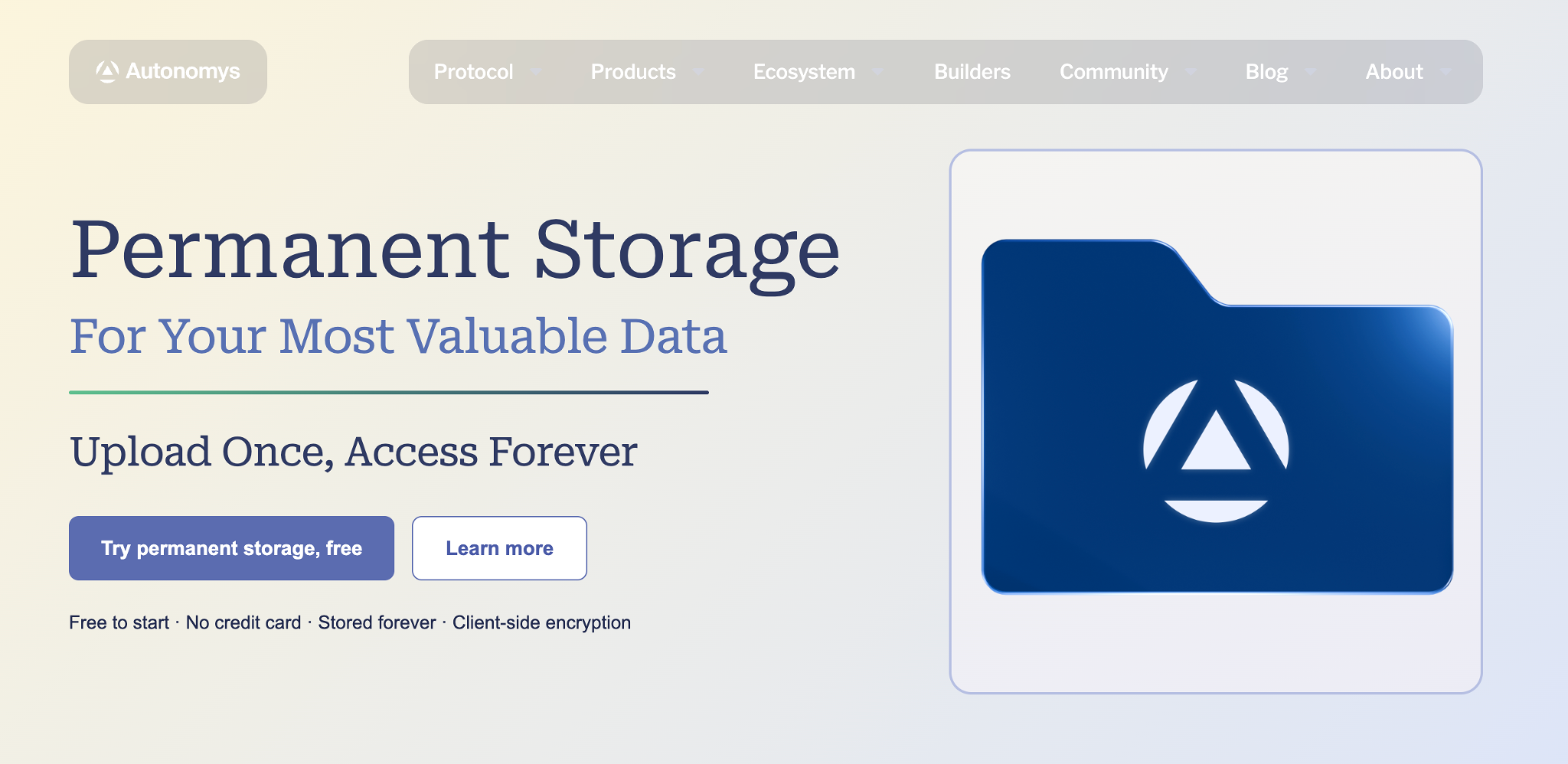
The redesigned homepage leads with one idea, "Upload Once, Access Forever," and a single action: try permanent storage for free. Rather than explaining the protocol first, it starts with what people most want to keep safe, from compliance and audit trails to contracts, financial records, research data, personal files, and AI agent memory.
The rest of the page stays just as practical. You reach it through interfaces you already know, from the web app to the Auto SDK, a REST API, and an S3-compatible layer. All of them run through Auto Drive, our user-friendly gateway to Autonomys' distributed storage network (DSN), where your data is kept securely and permanently.
Encryption is on your terms. Turn it on and your files are encrypted on your own device with AES-256-GCM, the same standard trusted by financial institutions and governments worldwide, and one built for the quantum era. Pricing follows the same logic. Unlike most storage services, where you pay continuously to rent space, Auto Drive lets you pay once and store forever, and even offers a free tier of 20 MB of complimentary uploads each month for anyone who wants to try it at no cost.
A dedicated site for AI agents
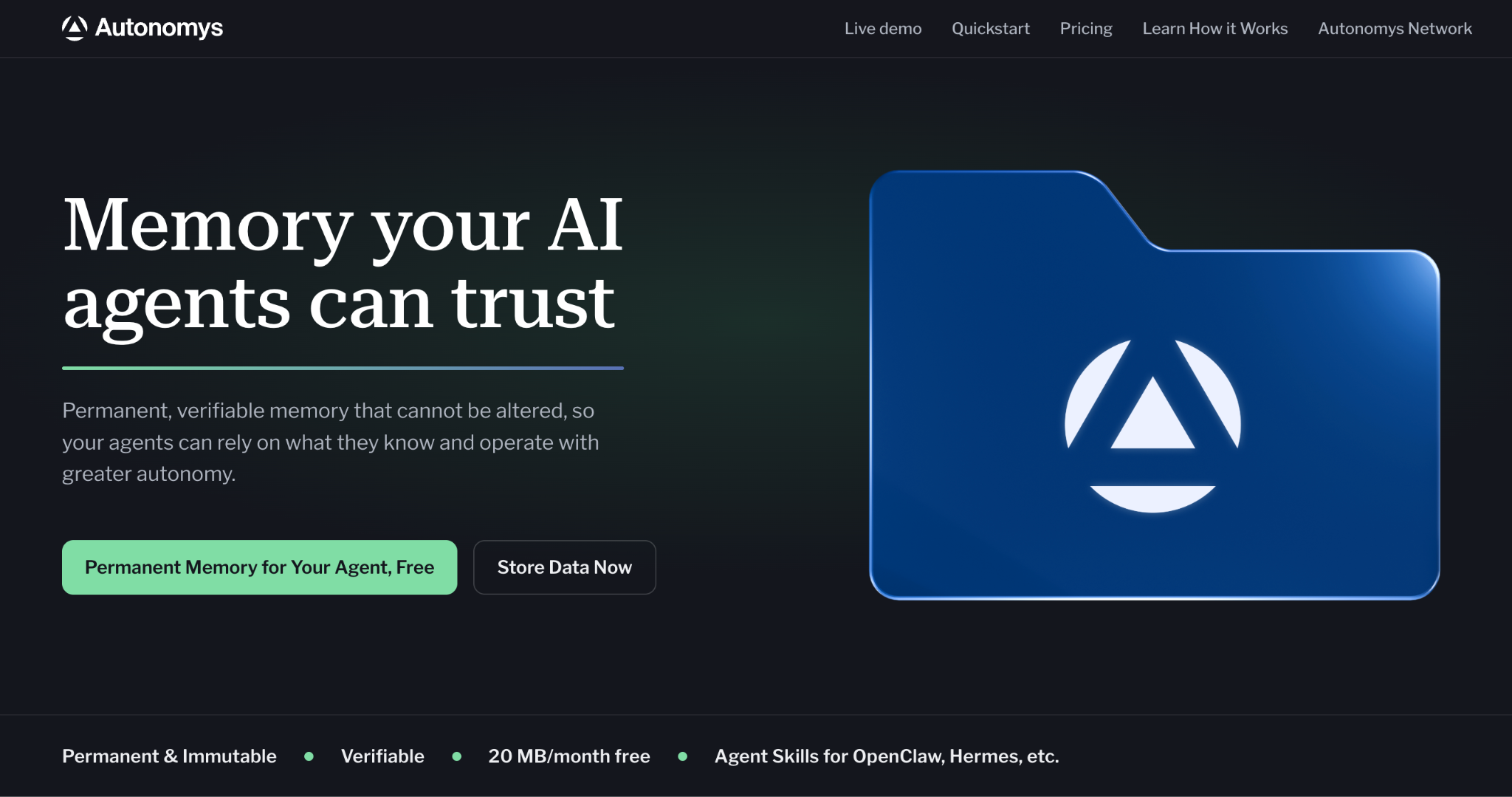
The new agent site helps people building AI agents, along with the agents themselves, find and use permanent storage without wading through the rest of the stack. Its focus is memory your AI agents can trust. Hallucination is the known problem; unverifiable memory is the silent one. You choose the model, write the prompt, and audit the tools, yet what an agent reads back is often the one variable outside your control. Permanent storage closes that gap. Memory stored on Autonomys cannot drift between calls, cannot be quietly rewritten, and cannot vanish. A short code sample saves a memory in a few lines and returns a content identifier (CID) your agent verifies on every read. Each memory points back to the one before it, forming a chain, so a new instance can rebuild its full history from a single address. The site also lists skills for frameworks like OpenClaw and Hermes, and highlights that the free tier of 20 MB a month is enough for most agents.
Same goal, two front doors
The homepage speaks to a broad set of people with data worth keeping. The agent site speaks to a narrower audience with a sharper need. Both point to the same permanent storage, and both start you in the same place.
If you have records worth keeping, start here: autonomys.xyz, and try permanent storage for free at ai3.storage.
If you are building AI agents, start here: agent.autonomys.xyz, with agent memory documentation at develop.autonomys.xyz/agentic_memory.


