


Autonomys Mainnet Phase-2 Transfer Enablement Scheduled for July 16, 2025 (16:00 UTC)


The Subspace Foundation will enable native token transfers on the Autonomys Network at 16:00 UTC on Wednesday, July 16, 2025. This activation marks the formal start of Mainnet Phase-2 and will introduce asset mobility across the protocol.
Why Transfer Enablement Matters
This milestone signals the transition from a bootstrapped core infrastructure to an operational decentralized network with active user-driven value flow.
When transfers go live, the network stack will include:
- A globally distributed, high-throughput Decentralized Storage Network (DSN) that is permissionless and permanent
- Auto Drive, giving users intuitive access to DSN-stored content
- The Auto SDK, providing developers with tools to build, read, and write to the DSN programmatically
- The Auto Agents Framework and MCP tooling, enabling AI agents with on-chain verifiability and permanent memory
- A network where transfers are possible, unlocking ecosystem utility and bringing the token economy online
Community Livestream — July 16, 2025 (16:00 UTC)
To commemorate the milestone, the Foundation will host a Mainnet Phase-2 Launch Party via livestream featuring:
- Enable transfers live
- Introduce the Dawn of Autonomy community campaign
- Share updates on domains
- Discuss exchange listing plans
- Unveil the new grants program and ecosystem growth strategy
The event will be broadcast on Autonomys’ YouTube, X (Twitter), and additional channels.
Community questions may be submitted ahead of time at:
https://forms.gle/bENpqWCBiY8kk8Ls8
Next Steps
Transfer enablement marks the start of a broader Phase-2 rollout planned for the coming quarters. This includes:
- Auto EVM domain launch and application deployment
- Expanded Auto Drive and Auto Agent functionality
- Enhanced support for developer tooling and standards
- New integrations and ecosystem incentives
Farmers, builders, partners, and all community members are encouraged to join the livestream for information on community initiatives, LIVE transfer activation, next steps for domains and exchanges and opportunities to participate in the next phase of Autonomys.
Announcement issued by the Subspace Foundation.
Security Milestone: SRLabs Audit Confirms Autonomys Mainnet Phase-2 Readiness
Security Audit Wraps Ahead of Mainnet Phase-2, Clearing Path to Token Transfers
Subspace Foundation is pleased to announce that Autonomys has reached a decisive inflection point: Security Research Labs (SRLabs) has concluded the latest installment of its Continuous Security Assurance of the Autonomys Network. The audit — focused predominantly on domains and supporting architecture including cross-domain messaging (XDM), fraud-proof pipeline, Proof-of-Time, and Proof-of-Archival-Storage — completes a critical hardening step ahead of Mainnet Phase-2.
Audit in Numbers
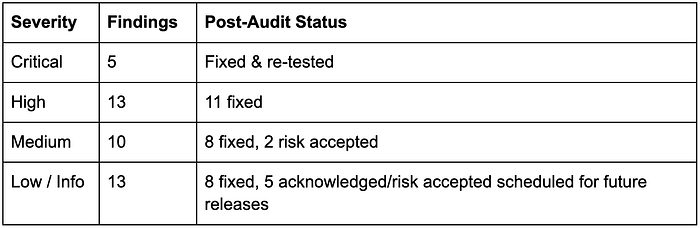
Takeaway: All critical security items identified by the audit have been addressed and remaining items are lower-priority improvements that are being tracked publicly on our roadmap.
What Changed Under the Hood
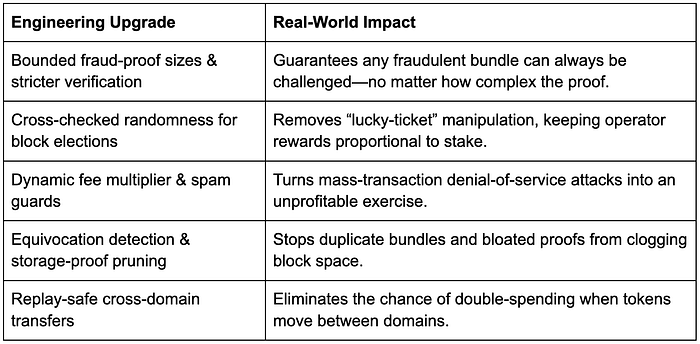
Implications for the Autonomys Ecosystem
- Investors gain further reassurance that the core business logic — where value moves and data lives — resists the most sophisticated exploits known today.
- Builders on Auto EVM and future domains can ship with confidence.
- Farmers, agents, and end-users benefit from improved network reliability and security hardening validated through independent assessment.
Closing Outlook
With audit barriers lifted, the network roadmap now advances to Mainnet Phase-2, which will introduce $AI3 token transferability, roll out the production domain layer, and launch Auto EVM for smart-contract deployment. Going forward, critical code will continue to be audited for vulnerabilities, and a public bug-bounty program will launch alongside token transferability.
To view and read the full audit report, visit: https://github.com/subspace/audit-reports/blob/main/Autonomys_continuous-security-audit-domains.pdf
— Announcement issued by the Subspace Foundation
About Autonomys
The Autonomys Network — the foundation layer for AI3.0 — is a hyper-scalable decentralized AI (deAI) infrastructure stack encompassing high-throughput permanent distributed storage, data availability and access, and modular execution. Our deAI ecosystem provides all the essential components to build and deploy secure super dApps (AI-powered dApps) and on-chain agents, equipping them with advanced AI capabilities for dynamic and autonomous functionality.
X | LinkedIn | Discord | Telegram | Blog | Docs | GitHub | Forum | YouTube
Autonomys x Fireverse: Permanent On-Chain Storage for Decentralized Music Metadata
Autonomys is pleased to announce a strategic partnership and integration with Fireverse, a decentralized music platform reimagining how music is created, owned, and monetized through AI and Web3 technologies.
Key Aspects of the Partnership
- Auto Drive Integration for Persistent Music Metadata
Fireverse has already integrated Autonomys’ Auto Drive — enabling permanent, verifiable on-chain storage for music-related metadata, media assets, and creator records. This ensures that music minted on Fireverse remains accessible, tamper-proof, and user-owned for the long term thanks to Autonomys’ “pay once, store forever” model. - Exploration of the Auto SDK for Platform-Wide Utility
Fireverse is currently evaluating the Auto SDK as a modular integration layer across its broader product stack, assessing how developers can leverage decentralized storage and access patterns to support real-time music discovery, licensing, and creator verification. - Collaborative Use Case Development and Technical Exploration
Autonomys and Fireverse will continue working together to explore how decentralized infrastructure can support emerging music platform needs from permanent asset storage to new patterns in user engagement, licensing, and digital provenance.
“With Autonomys’ DSN, we’re reinforcing the foundation of our platform with storage that’s as trustless and accessible as our mission. It’s a meaningful step toward giving creators real ownership of their music and metadata.” William, COO at Fireverse
“Fireverse is tackling real challenges in creative ownership and platform fairness. We’re proud to support their journey with decentralized infrastructure, and we look forward to exploring further integrations that empower creators through verifiable data and trustless access.” Jim Counter, Head of Ecosystem at Autonomys
About Fireverse
Fireverse is a decentralized music platform combining AI-powered creation tools with blockchain-native ownership and monetization. Artists can mint music as NFTs, license their work on an open marketplace, and earn tokens through community engagement and direct support. Fireverse empowers creators by dismantling traditional industry barriers and providing blockchain-secured copyright protection, innovative revenue models, and a collaborative global community of musicians and fans.
About Autonomys
The Autonomys Network — the foundation layer for AI3.0 — is a hyper-scalable decentralized AI (deAI) infrastructure stack encompassing high-throughput permanent distributed storage, data availability and access, and modular execution. Our deAI ecosystem provides all the essential components to build and deploy secure super dApps (AI-powered dApps) and on-chain agents, equipping them with advanced AI capabilities for dynamic and autonomous functionality.
X | LinkedIn | Discord | Telegram | Blog | Docs | GitHub | Forum | YouTube
Autonomys x Heurist: Decentralized AI Storage for Agentic Applications
Autonomys is pleased to announce astrategic partnership with Heurist, a decentralized AI-as-a-Serviceplatform pioneering composable intelligence and privacy-preservinginfrastructure for agent economies.
Key Aspects of thePartnership
- Integration of Autonomys’ Decentralized Storage Network (DSN)
Heurist will integrate Autonomys’ DSN to supportpermanent, verifiable storage for its research app, image minting features, andHeurist Imagine interface—ensuring AI-generated outputs are cryptographicallystored and persistently accessible. - Joint Experimentation and Agent Verification
Both parties will collaborate on experimental agentflows, exploring how decentralized storage can enhance Heurist’s agentverification and composability layers, supporting future innovations acrossresearch and data provenance. - Shared Ecosystem Growth and Developer Engagement
Autonomys and Heurist will work together on activitiessuch as hackathons, developer programs, and educational content to growadoption across the decentralized AI ecosystem.
Community Benefits
“Reliable, verifiable, and decentralized storage iscritical infrastructure for agent systems. Partnering with Autonomys allows usto preserve the integrity of research artifacts and image data across ourapplications, and gives our developers tools they can trust.” JW, CEO atHeurist
“We’re excited to support Heurist’s decentralized AIstack and experiment together on anchoring agent-generated data tochain—securely, verifiably, and permanently.” Jim Counter, Head of Ecosystem at Autonomys
About Heurist
Heurist is a decentralized AI-as-a-Serviceplatform built on a privacy-preserving ZK Layer-2. It enables an open andcomposable agent economy by allowing developers to create modular AI agentswith capabilities such as reasoning, tool execution, memory, deep research, andon-chain interaction. The Heurist Mesh includes 30+ live agents accessible viaAPI or fully managed through its Multi-Agent Control Panel (MCP). Through aunified API key and credit system, developers gain access to all agents,open-source models, and data services within the ecosystem. Heurist also offersan AI dApp Store, where applications built on this infrastructure can bediscovered, composed, and monetized.
X | Docs | GitHub
About Autonomys
The Autonomys Network—the foundation layer forAI3.0—is a hyper-scalable decentralized AI (deAI) infrastructure stackencompassing high-throughput permanent distributed storage, data availabilityand access, and modular execution. Our deAI ecosystem provides all theessential components to build and deploy secure super dApps (AI-powered dApps) andon-chain agents, equipping them with advanced AI capabilities for dynamic andautonomous functionality.
X | LinkedIn| Discord| Telegram| Blog| Docs| GitHub| Forum| YouTube
Autonomys x SpoonOS: Powering the Next Generation of On-Chain Agents
Autonomys is pleased to announce an integration with SpoonOS to power the next generation of AI agents and lay the groundwork for the emergence of a sentient economy.
Highlights
- Permanent On-Chain Storage: SpoonOS has begun storing agent data permanently on-chain using Autonomys’ distributed storage network (DSN) via an integration with Auto Drive.
- Model Context Protocol: SpoonOS agent builders can store agent data on Autonomys’ DSN via native Model Context Protocol (MCP) integrations with Auto Drive and the SpoonOS agent framework.
- Agent Interoperability: SpoonOS joining the AI3.0 ecosystem will facilitate coordination between SpoonOS and Auto Agents via its Agent Interoperability Protocol.
“SpoonOS is building a compelling approach to agent infrastructure — one that prioritises modularity, privacy and scalability. By integrating Auto Drive, they’re giving developers a powerful way to persist agent memory, context and state on-chain in a permissionless, scalable and verifiable way. This is exactly the kind of innovation we envisioned when building the Autonomys DSN, and we’re excited to help accelerate the agent economy together.” Jim Counter, Head of Ecosystem at Autonomys
About SpoonOS
SpoonOS is a universal agentic operating system equipped with a comprehensive toolkit and a rich ecosystem purpose-built to meet the growing demands of AI agent developers. Using Trusted Execution Environments (TEEs) to run large models securely, and zero-knowledge proofs (ZKPs) and fully homomorphic encryption (FHE) for privacy, SpoonOS enables agents to access comprehensive web2 and web3 data, interact, and execute tasks in parallel.
Introducing Auto Secret Agent
Autonomys is pleased to announce Auto Secret Agent, a proof-of-concept built alongside Secret Network, that combines the permanent, auditable memory provided by Autonomys’ DSN with Secret’s cryptographically verifiable, TEE-based computation to ensure complete on-chain AI agent accountability.
Verifiable Auto Agent Execution
Autonomys Agents (Auto Agents) use Autonomys’ distributed storage network (DSN) — accessible via the Auto Drive API — to permanently archive their memory, including reasoning chains, decisions, and input/output interactions.
Auto Secret Agent runs an Autonomys Agent inside a Trusted Execution Environment (TEE) — leveraging confidential SecretVMs based on Intel TDX technology and the Secret AI SDK — to provide a trusted off-chain compute context for sensitive tasks, showcasing how third-party layers can interoperate with Autonomys’ composable architecture.
The agent’s attestation can be accessed via its virtual machine, enabling users to independently verify the integrity of the SecretVM and the provenance of the agent’s source code. The result is greater user confidence in agent outputs for trust-critical use cases, while preserving transparency and auditability through on-chain memory.
Build an Auto Secret Agent
Interested in building your own verifiable on-chain Auto Agent that:
- is censorship-resistant and cryptographically verifiable,
- can store, retrieve, and learn from permanent memory across workflows, and
- can prove behavior at runtime using TEE attestations?
Get started with the Auto Agents Framework!
“Auto Secret Agent exemplifies the power of confidential computing in the AI era — giving users cryptographic proof that agents behave as intended, without compromising sensitive data. This is exactly the kind of innovation we envisioned when building our secure compute layer: empowering transparency, accountability, and privacy all at once.” Lisa Loud, Executive Director of Secret Foundation
“Auto Secret Agent offers a glimpse into the future of decentralized intelligence. By combining Autonomys’ DSN and Auto Agent Framework with Secret’s confidential execution layer, this marks one of the first real-world deployable applications of verified agentic behavior. We’re excited to see what the ecosystem begins to build as we continue laying the groundwork for a new class of on-chain agents that can act independently, provably, and without compromising user safety or privacy.” Amik Ahmad, Head of Product at Autonomys
About Secret Network
Secret Network is the first Layer-1 blockchain with privacy-preserving Turing-complete smart contracts. Using Trusted Execution Environments (TEE), it enables developers to build dApps that are encrypted by default, as well as verifiable and confidential use cases for AI, while also offering selective disclosure tools such as viewing keys and permit technology for compliance and auditability. Secret Network’s confidential computing layer is interoperable with 130+ blockchain networks, including Cosmos, Ethereum and Solana.


