



To our community, partners, and supporters,
2025 was the year Autonomys transitioned from foundational infrastructure to a fully activated, production-ready network. We entered the year with a live Proof-of-Archival-Storage (PoAS) mainnet and a growing distributed storage network (DSN). We close the year with Domains deployed, Auto EVM live, token transfers enabled, exchange markets established, and an expanding ecosystem of builders, partners, and agents integrating real workloads.
Across consensus, storage, execution, and token infrastructure, Autonomys now operates as a vertically integrated, AI-native Layer 1 designed to support permanent, verifiable data and modular on-chain agents at scale.
At the protocol level, the year was defined by the delivery and hardening of Mainnet Phase-2. At the execution layer, we activated Auto EVM to bring permissionless smart contracts online. At the economic layer, we enabled token transfers, launched the Guardians of Growth Staking Incentives Program, and established liquid markets across multiple centralized and decentralized venues.
By December 2025, the Autonomys ecosystem encompassed 60 partners and integrations across infrastructure, exchanges, AI agents, AI data, DePIN, wallets, security, and DeFi. These collaborations reflect a deliberate focus on permanence, verifiability, and scalable AI-native execution rather than integration volume alone.
With consensus, execution, storage, and liquidity now successfully in place, our focus has sharpened toward long-term cryptographic resilience and permissionless scalability. Autonomys is preparing early for challenges and demands that may emerge years from now, ensuring the network remains durable, trustworthy, and capable of supporting the next generation of AI-native workloads.
This is our 2025 year in review, with a brief look at the priorities and developments on the horizon for 2026.

At the protocol level, 2025 was defined by the delivery and hardening of Mainnet Phase-2.
This preparation culminated mid-year in the formal activation of Mainnet Phase-2.
Token transfers were enabled at the protocol level on July 16, 2025, followed shortly by the launch of Auto EVM, introducing permissionless smart-contract deployment integrated with the DSN.
These steps completed the transformation from a foundational consensus chain into a full-stack execution environment where agents, applications, and data-rich workloads can operate on a single, coherent network.

Security remained a primary focus throughout 2025.
SRLabs concluded the 2025 audit cycle covering Domains, Cross-Domain Messaging (XDM), Proof-of-Time (PoT), Proof-of-Archival-Storage (PoAS), and fraud proofs, with all critical findings addressed before mainnet launch, and remaining optimizations tracked publicly as part of our continuous security commitment.
Combined with the performance and reliability work carried out during Q1, these efforts ensured that Mainnet Phase-2 went live on a robust foundation designed to withstand operational stress, adversarial behavior, and long-term usage patterns.

2025 also marked the year Autonomys began to fully realize its role as infrastructure for AI-native development.
Major upgrades to the Auto Agents Framework included:
Later in the year, the release of AgentOS and the first Auto SDK MCP server further streamlined integration between agents, Auto Drive, and DSN-backed storage, making it easier for developers to connect agent frameworks to permanent, verifiable memory.
The DSN matured substantially:
To match these infrastructure advances, Autonomys invested in developer enablement:
Together, these initiatives made it easier for developers to understand the architecture, experiment with agents and storage, and build composable applications on top of the Auto Suite.

The economic layer of Autonomys evolved significantly across the year.
Token transfers were activated at block 3,585,226, unlocking the network’s economic layer and enabling participating builders to move seamlessly into staking, rewards, and Domain-based applications.
To encourage a broad and resilient validator and nominator set, the Subspace Foundation launched the Guardians of Growth Boosted-Staking Initiative, allocating 5,000,000 AI3 over approximately twelve months to incentivize operator and nominator participation.
Join Medium for free to get updates from this writer.
Subscribe
By September, roughly 28 million AI3, about 25 percent of the circulating supply, was staked on the network. Today, that figure has grown to over 34 million, representing approximately one-third of circulating supply.
All token listing and liquidity operations were conducted by the Subspace Foundation, preserving separation between protocol development and market operations.
In August, the Foundation coordinated:
These actions established a globally accessible token ecosystem while maintaining clear boundaries between governance, engineering, and market infrastructure.

2025 Ecosystem Snapshot
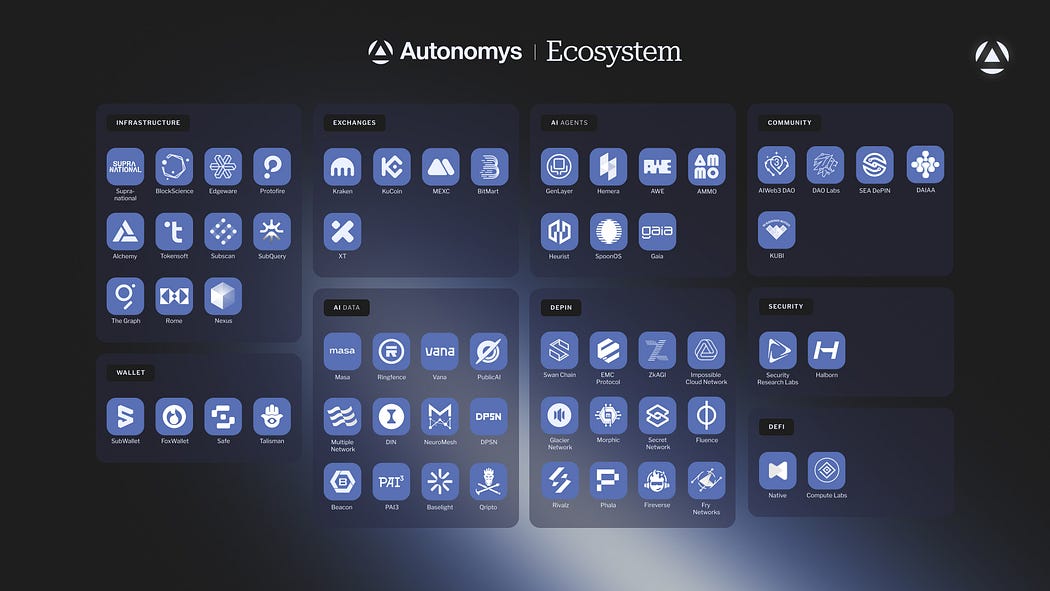
Autonomys’ ecosystem expanded substantially in 2025 as more teams adopted infrastructure designed for permanence, verifiability, and scalable AI-native execution. Many collaborations deepened earlier engagements, while others represented new integrations across AI data pipelines, agent frameworks, decentralized storage, and DSN-backed verifiable memory.
Autonomys began the year with 30 partners. By December 2025, the ecosystem reached 60 partners and integrations, doubling in size in a single year. Additional integrations are underway and will be announced in early 2026. As we head into the new year, the expanding ecosystem will continue to shape how builders use Autonomys for persistent data, agent execution, and decentralized AI development.

Autonomys’ developer and community base expanded meaningfully as the network matured.
In July, the Subspace Foundation introduced the Ecosystem Grants Program to fund Infrastructure, AI-powered dApps and Agents, Integrations, Research, and Community growth. Designed as a long-term investment in ecosystem health, the program supports the foundational components, applications, and communities that enable the Autonomys Network to grow sustainably. Early applications began arriving immediately following token listings. These initiatives created a pipeline for new projects, improved documentation, and aligned community efforts with the network’s technical roadmap, helping ensure that Autonomys grows in a focused and durable way.

In November, the Autonomys Engineering Roadmap was released, outlining priorities across three tracks: Application, Protocol, and Research.
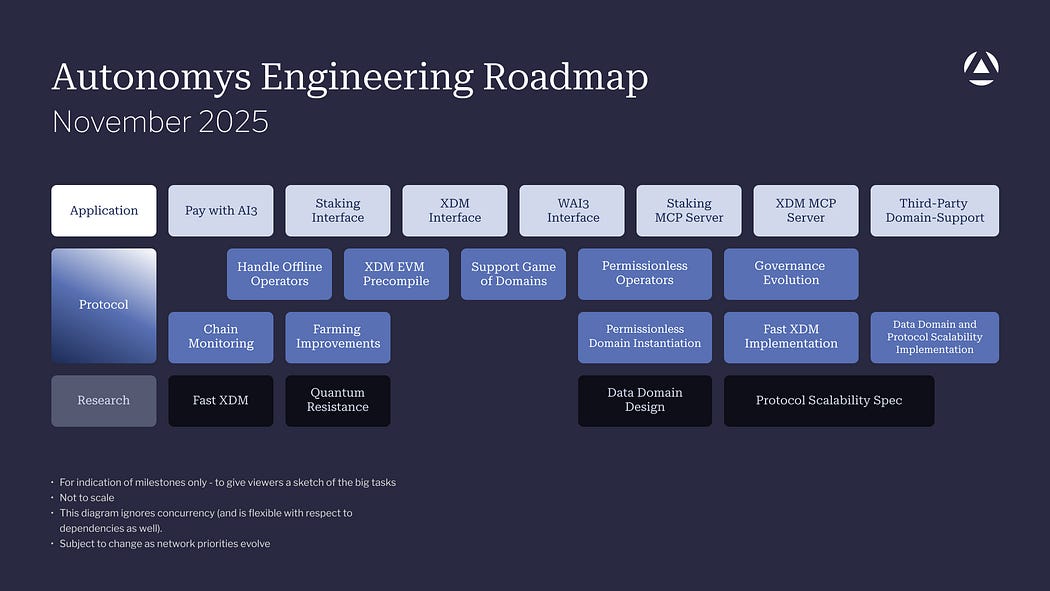
These tracks guide the next stage of network evolution:
Our ongoing post-quantum cryptography (PQC) research continues in parallel with these roadmap tracks to ensure long-term cryptographic resilience as the network evolves.

2025 was the year the Autonomys Network transformed from a whitepaper into a fully functional network. In a space filled with hype and empty promises, that is no small accomplishment. This was only possible because our farmers, developers, and community members believed it was worth building and stuck around to see it through.
The hard part was never the technology, but getting people to use it. With the technical foundation in place, what matters now is adoption. For 2026, we are focused entirely on building traction, by bringing in projects that need what we built, and showing why it solves real problems. We are putting our resources behind this through our grants program, which will fund infrastructure development, AI-powered applications, and ecosystem integrations. That means targeted outreach to developers that require permanent, verifiable storage.
I’m thankful for all the hard work from our team, ambassadors, and everyone who has supported us over the years. Wishing you a happy holiday season, and a healthy and prosperous 2026.
— Todd Ruoff
[CEO, Autonomys]
[ X ] | [ LinkedIn ]

Фундаментальный уровень для AI3.0


